
November 12, 2026
LIFENET INSURANCE COMPANY
This page provides the presentation slides and speech text from the 2Q Financial Results Briefing for the Fiscal Year Ending March 2027 (FY2026).
<Event Overview>
Date: November 12, 2026
[Speaker]
Junpei Yokozawa — President and Representative Director
Takeshi Kawasaki — Director, Executive Vice President, CFO
Yokozawa: Thank you very much for joining LIFENET INSURANCE COMPANY's financial results briefing for the second quarter of fiscal 2026 today.
I will begin by outlining the highlights of our 2Q financial results briefing, followed by a summary of the financial results from Mr. Kawasaki, our Executive Vice President and CFO. Following that, I will explain our initiatives for accelerating growth in the second half of our FY2028 mid-term business plan.
Let us now begin the presentation.
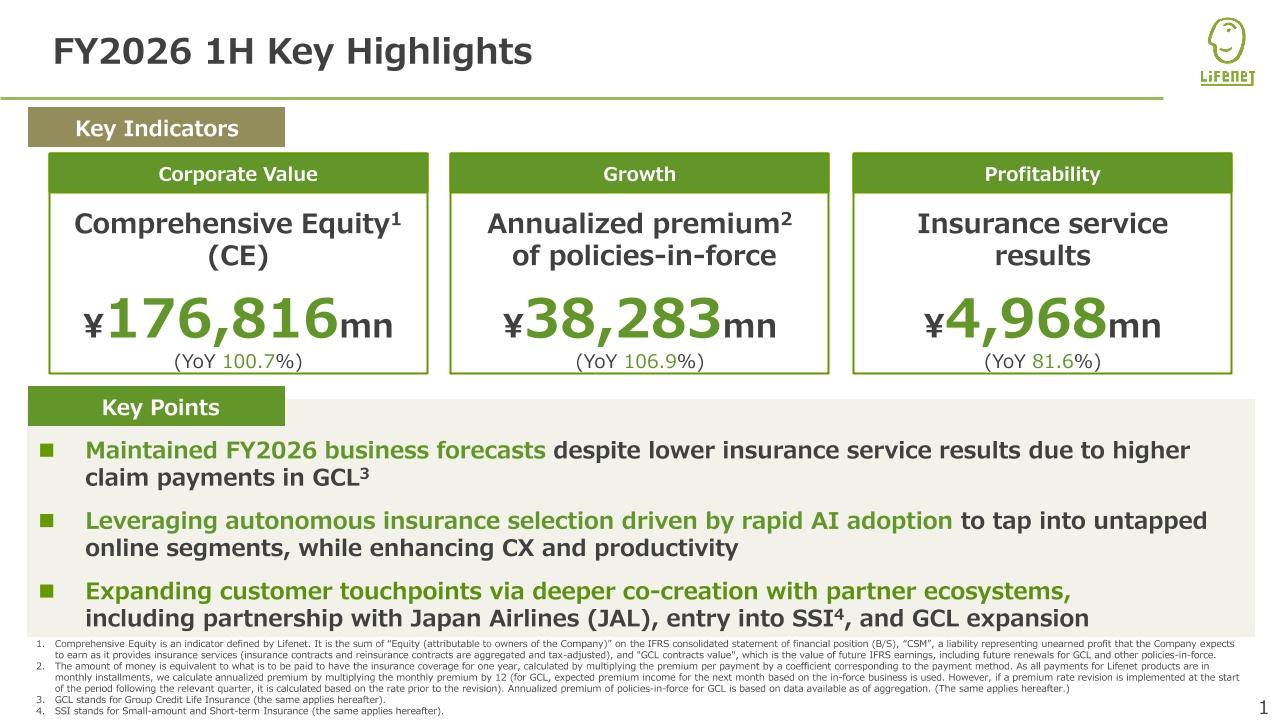
Yokozawa: Please see page 1. Here are the highlights of the financial results for the second quarter of fiscal 2026.
First, let's look at our 2Q results.
Comprehensive Equity (CE), our most important management indicator representing corporate value, reached JPY176,816 million, or 100.7% compared to the end of the same period last year. Next, annualized premium of policies-in-force increased by 6.9% year-on-year to JPY 38,283 million. As for the insurance service results, Mr. Kawasaki will explain it later, it came to JPY 4,968 million, or 81.6% year-on-year, mainly due to an increase in claims and benefits paid in group credit life insurance (GCL).
Next, I will introduce three main points of today's briefing.
Regarding the first point, our performance, although our insurance service results was currently lower than our forecast due to the factors I just explained, we maintain our full-year performance forecast unchanged from the one announced in May.
The second and third points concern initiatives aimed at accelerating growth in the second half of the mid-term business plan.
The first is our AI strategy. With the explosive spread of AI, an irreversible structural change in the market is occurring, leading to "autonomous insurance selection". We see this change as a golden opportunity to accelerate our efforts to reach online customers who haven't yet joined our insurance market, create "Ultimate Insurance Experience" using AI and technology, and improve productivity.
Another point, which is listed as the third item in the bullet points, is strengthening partnerships with partner companies. Our partnership with Japan Airlines Co., Ltd. (JAL) is progressing smoothly, and both companies are currently working together intending to launch the product within FY2026.
Additionally, through our entry into the small-amount and short-term insurance (SSI) business announced in October and the expansion of partner banks for GCL, we will further deepen co-creation with partner ecosystems and promote the multifaceted expansion of customer touchpoints.
Through these measures, we aim to accelerate growth in the second half of our mid-term business plan, enhance corporate value, and achieve our mid-term business plan objectives.
Page 2 contains today's table of contents.
Mr. Kawasaki, CFO, will now provide an overview of our second quarter financial results.
Kawasaki: I am Kawasaki, Executive Vice President and CFO. I will now explain the financial results for the first half of FY2026.
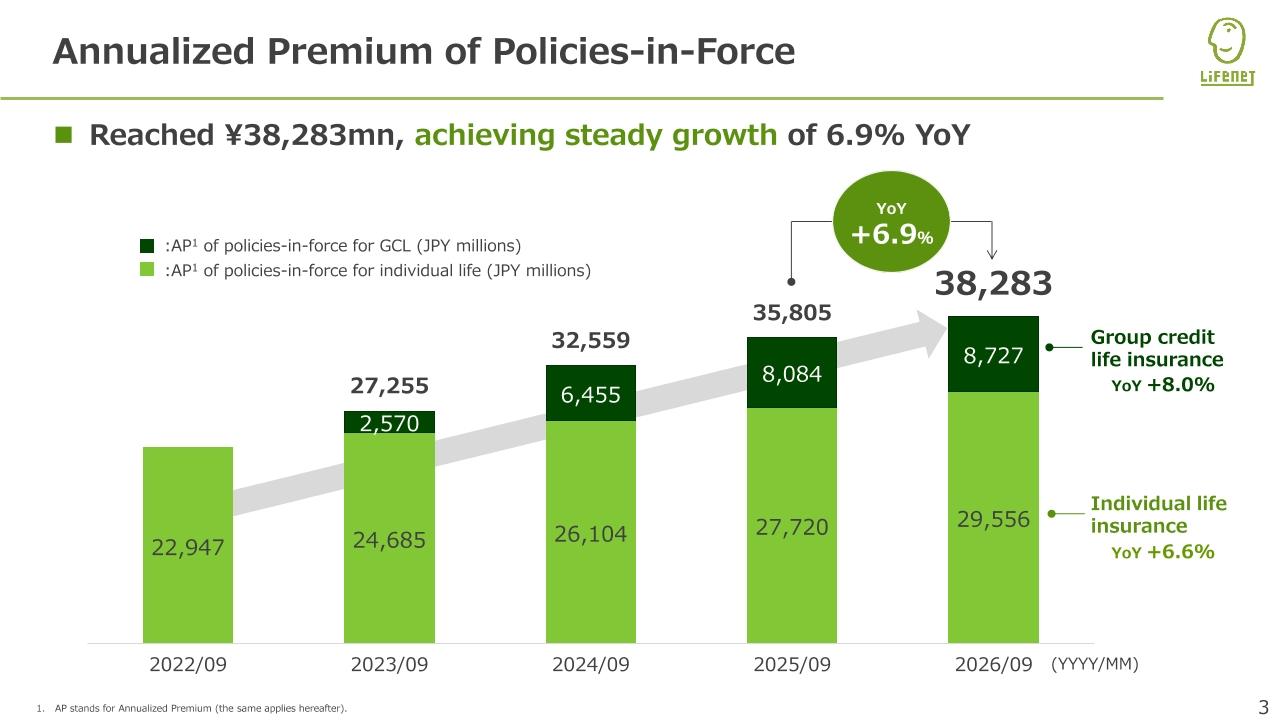
Please see page 3.
Annualized premium of policies-in-force, our growth indicator, reached JPY38,283 million as of the end of September 2026, up 6.9% from the end of the same period last year. Breaking it down, individual insurance was 106.6% and group credit life insurance (GCL) increased to 108.0% compared to the end of the previous fiscal year, showing steady growth in both businesses.
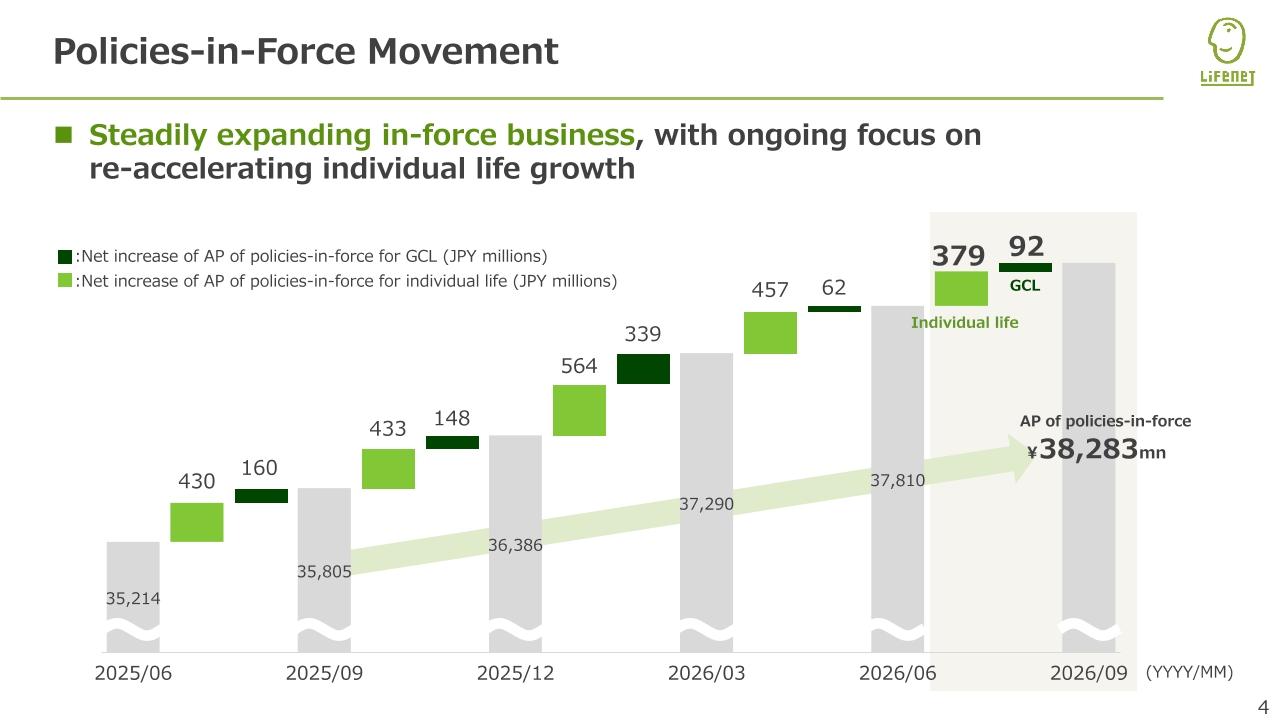
Kawasaki: Page 4 shows the quarterly net increase in annualized premiums for policies-in-force.
Regarding individual life insurance, while we have maintained steady accumulation of our policies-in-force, we recognize that re-accelerating the pace of growth is an issue. On this point, we will promote efficient advertising investments while closely monitoring market and competitor trends, advance collaborations with partner companies, and drive initiatives utilizing AI, which will also be discussed later.
Regarding GCL, we began our collaboration with THE KYOTO SHINKIN BANK in July, and new acquisitions contributed to the increase as of the end of September.
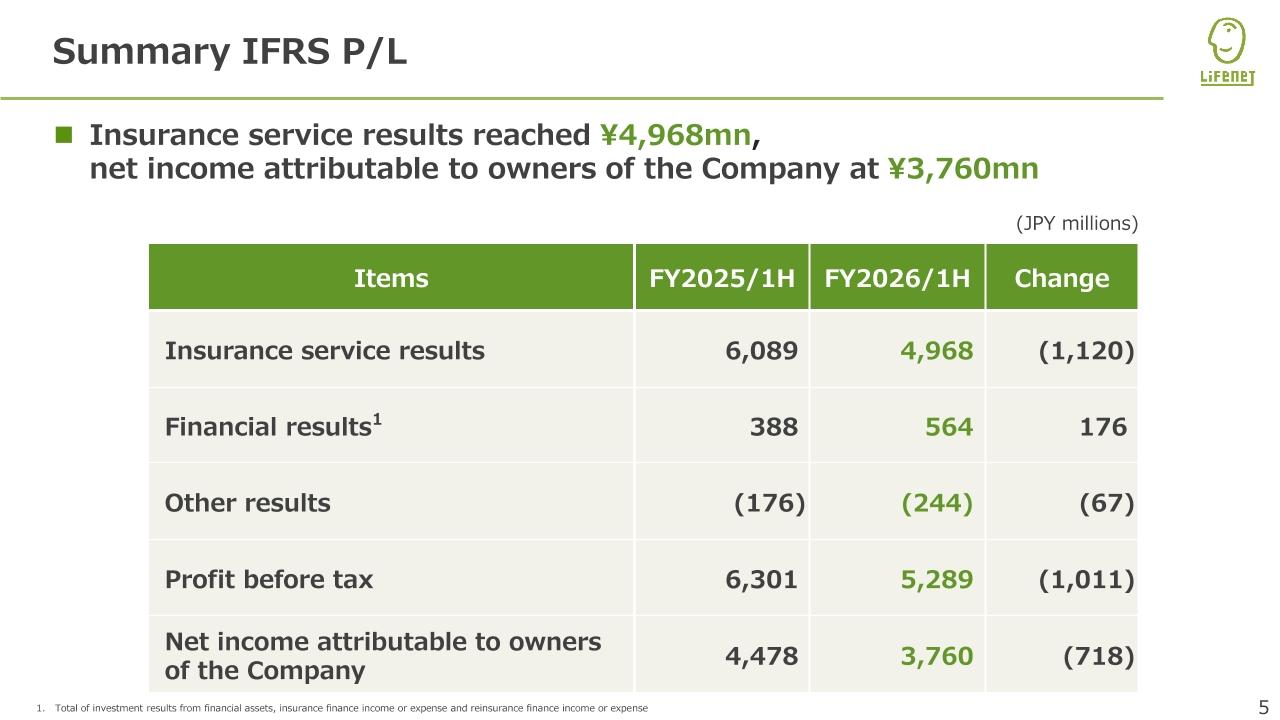
Kawasaki: Next, please turn to page 5.
From here, we move to IFRS-based financial reporting. To give you an overall picture, we present summary of IFRS P/L.
For the cumulative 2Q period, insurance service results were 4,968 million yen, and financial results were 564 million yen, driven by increased interest income from additional purchases of corporate bonds.
Insurance service results correspond to what is generally referred to as operating profit or loss, and as you can see, for a life insurance company like ours that focuses on protection-type products, insurance service results account for the majority of profits.
Net income attributable to owners of the Company came to 3,760 million yen.
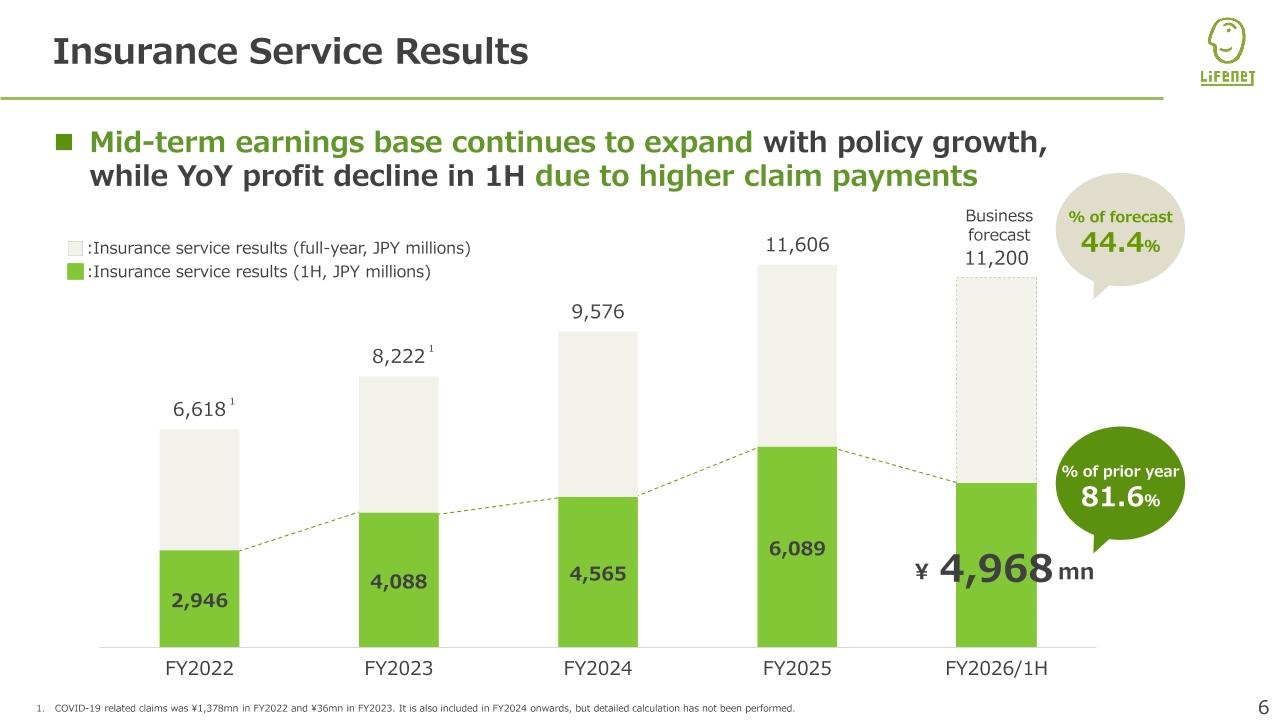
Kawasaki: Please see page 6. This shows the trend in insurance service results.
Along with the growth of policies-in-force, our mid-term earnings base itself is steadily expanding. However, in the first half of this fiscal year, profits declined to 81.6% year-on-year. I will explain the specific factors behind this variance in detail on the next page.
In addition, the progress rate against our full-year forecast of 11,200 million yen stood at 44.4% as of the end of 2Q. Considering that the progress rate at the end of 1Q was 18.8%, we believe 2Q standalone progressed as expected, though overall first-half progress remains behind schedule.
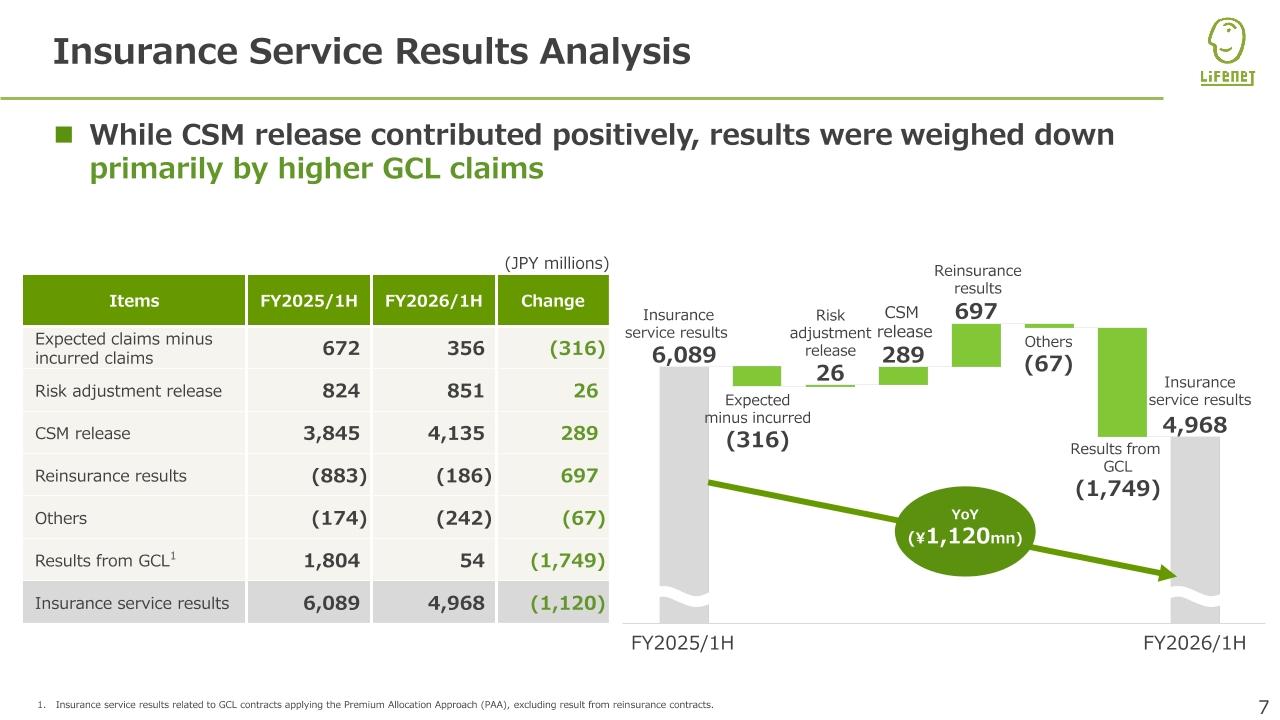
Kawasaki: Please see page 7.
This is a factor analysis of the 1,120 million yen decrease in profit, from 6,089 million yen in the same period last year—when claims and benefits payment experience was favorable—to 4,968 million yen this period.
The primary factor behind this decline, as shown under "GCL results" on the right side of the chart, was an increase in claims and benefits paid in GCL. Compared to 1,804 million yen in the same period last year, GCL results were 54 million yen this period, acting as a downward factor of 1,749 million yen. However, this impact was partially offset by a 697 million yen increase in reinsurance results due to reinsurance claim recoveries and other factors.
Additionally, the "Expected claims minus incurred claims" in individual insurance was minus 316 million yen year-on-year. However, this was mainly because the payment level in the same period last year was exceptionally favorable. The actual claims occurrence trend in individual insurance during the first half of this fiscal year remained well within expectations, maintaining a stable level.
"CSM release," which represents our underlying earning power and the accumulation of policy stock, increased by 289 million yen year-on-year to 4,135 million yen, supported by the expansion of policies-in-force. We will continue focusing on growing policies-in-force to achieve medium- to long-term profit growth so that temporary fluctuations in claims and benefits payments can be absorbed by CSM expansion.
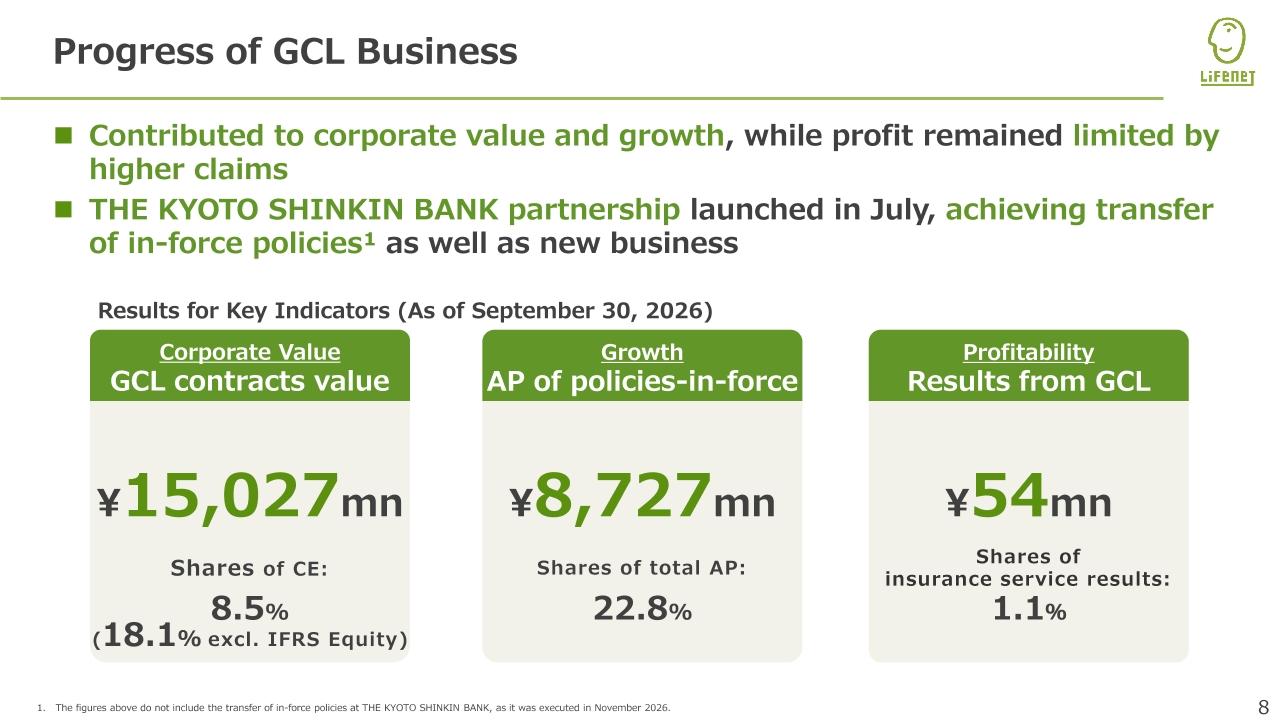
Kawasaki: Page 8 shows the progress of our GCL business.
The GCL business continues to account for roughly 20% of both the value of GCL contracts within Comprehensive Equity and annualized premium of policies-in-force, steadily contributing to our corporate value enhancement and scale expansion.
On the other hand, GCL results for the first half were 54 million yen, contributing only 1.1% to overall profit.
At our current GCL business scale, quarterly fluctuations in claims payments tend to cause volatility in profit and loss. To smooth out these fluctuations and stabilize earnings, further business scale expansion and risk diversification are essential.
As part of these efforts, we launched our collaboration with THE KYOTO SHINKIN BANK in July. Since the transfer of existing policies from THE KYOTO SHINKIN BANK is scheduled for November, it is not included in the 2Q financial results and is expected to contribute to performance from the second half onward.
We will continue focusing on expanding our network of partner financial institutions.
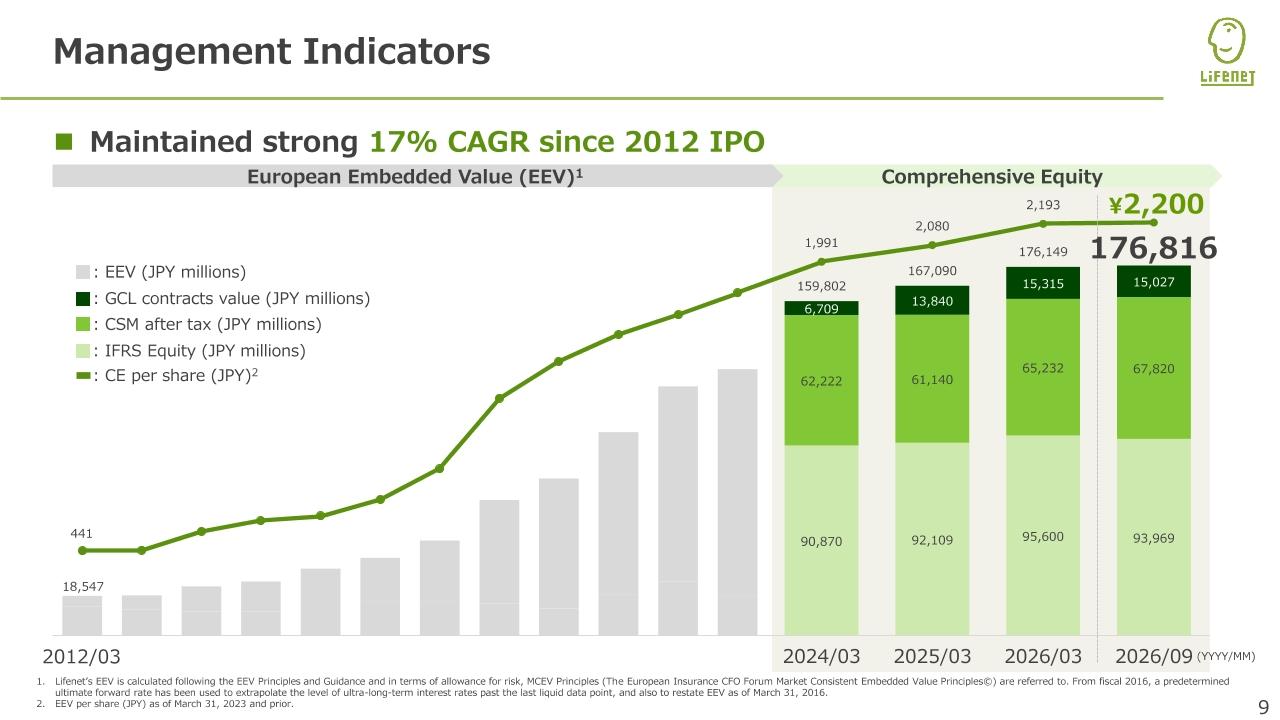
Kawasaki: Page 9 illustrates the long-term trend of Comprehensive Equity (CE), our corporate value indicator.
As of the end of September 2026, Comprehensive Equity reached 176,816 million yen, and CE per share stood at 2,200 yen.
The compound annual growth rate (CAGR) since our IPO is 17%, maintaining a strong long-term growth trajectory. We will continue working steadily toward our FY2028 targets set out in the mid-term business plan.
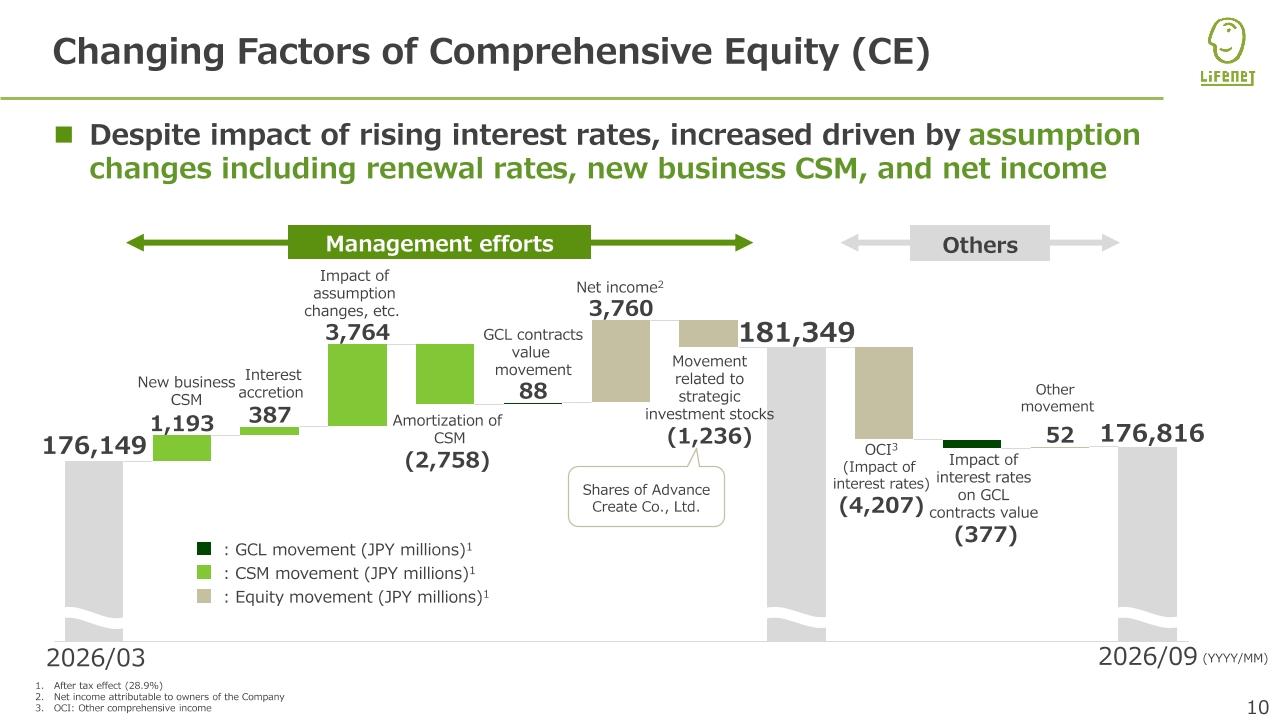
Kawasaki: Page 10 provides a factor analysis of changes in Comprehensive Equity over the six months from the end of March to the end of September 2026.
First, under "management efforts" on the left side of the chart, although there was a 1,236 million yen valuation loss on strategic investment stocks, we recorded 1,193 million yen in new business CSM, 3,760 million yen in net profit, and a 3,764 million yen increase from assumption changes and other adjustments, including revisions to renewal rates—resulting in a total increase of approximately 5.2 billion yen.
Meanwhile, under "other changes" on the right side of the chart, changes in discount rates due to rising interest rates and valuation changes on bonds holdings resulted in a negative impact of approximately 4.5 billion yen.
Although affected by rising interest rates, the increase driven by management efforts such as assumption changes and new business acquisitions offset the interest rate impact, allowing us to finish above the previous fiscal year-end level.
However, the upward trend in interest rates is expected to continue to some extent going forward.
On the next page, we have summarized our basic approach, which I will now explain.
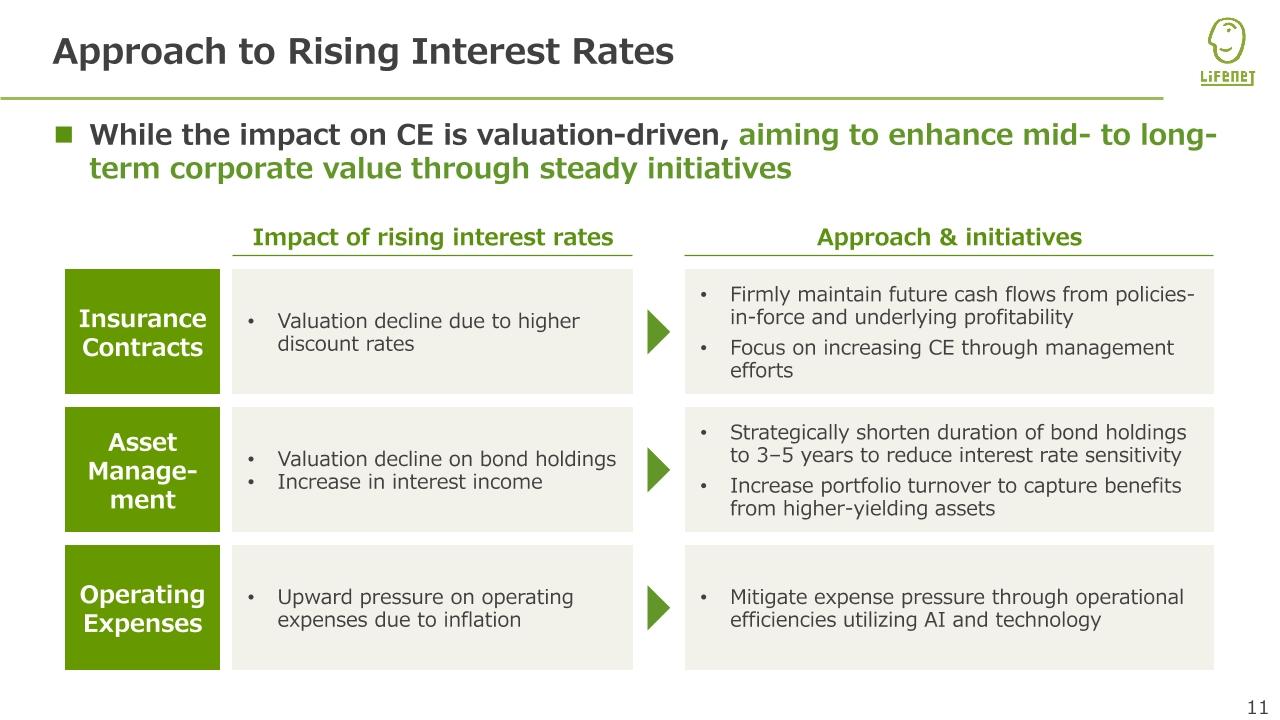
Kawasaki: Please turn to page 11.
There are two major components to how rising discount rates—stemming from higher interest rates—impact Comprehensive Equity.
One is insurance contract assets, and the other is held bonds, with the impact on insurance contract assets being particularly significant.
The impact on Comprehensive Equity is an accounting and valuation fluctuation caused by higher discount rates; it does not impair the future cash flows generated from policies-in-force or our underlying earning power, and by nature, it resolves over the long term.
In asset management, we have strategically shortened the duration of our bonds to around 3 to 5 years, appropriately controlling and curbing the impact of rising interest rates.
Furthermore, by increasing portfolio turnover, we have established a structure that allows us to capitalize on the current rising interest rate environment and capture reinvestment benefits early.
Regarding operating expenses, we will thoroughly drive operational efficiency using AI and technology—which will be explained later—to firmly absorb inflationary cost pressures.
At the same time, we recognize as a management challenge that growth from changes from "management efforts" on the left side of the page 10 chart has not yet substantially outweighed the interest rate impact.
We will build a resilient earnings base less susceptible to external environmental changes and focus on further boosting Comprehensive Equity through changes from "management efforts."
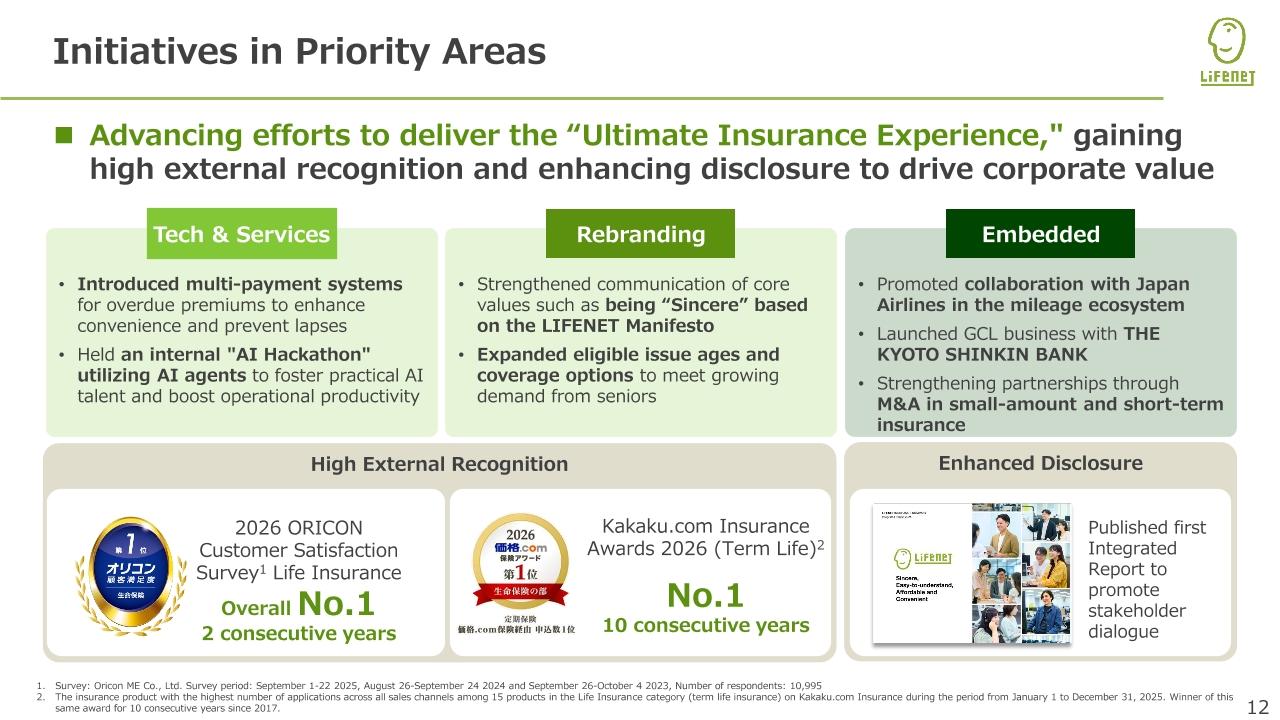
Kawasaki: Page 12 shows the current progress in the three priority areas of the mid-term business plan.
In Tech and Services, we have implemented a multi-payment system for overdue premiums, achieving both enhanced customer convenience and prevention of policy lapse. Although it has only recently been implemented, we are already seeing tangible results and positive feedback in our current operations. Furthermore, we are promoting improved AI literacy and practical operational efficiency throughout the organization by utilizing our in-house AI agent and holding AI hackathons in which all departments participate.
In Rebranding, we continue to promote the values we offer, such as being sincere, based on LIFENET Manifesto, while also continuing our effort to meet the needs of senior citizens by expanding the eligible issue age and lowering the minimum coverage amount.
In Embedded, we are accelerating our collaboration with Japan Airlines Co., Ltd., launching a group credit life insurance program with THE KYOTO SHINKIN BANK, and acquiring alliance bases through the acquisition of small-amount and short-term insurance companies.
As evidence of this exceptional insurance experience, we have consistently received top rankings and high praise in life insurance awards.
Furthermore, in order to help those in the capital markets gain a deeper understanding of these initiatives aimed at enhancing corporate value, we have issued a new integrated report.
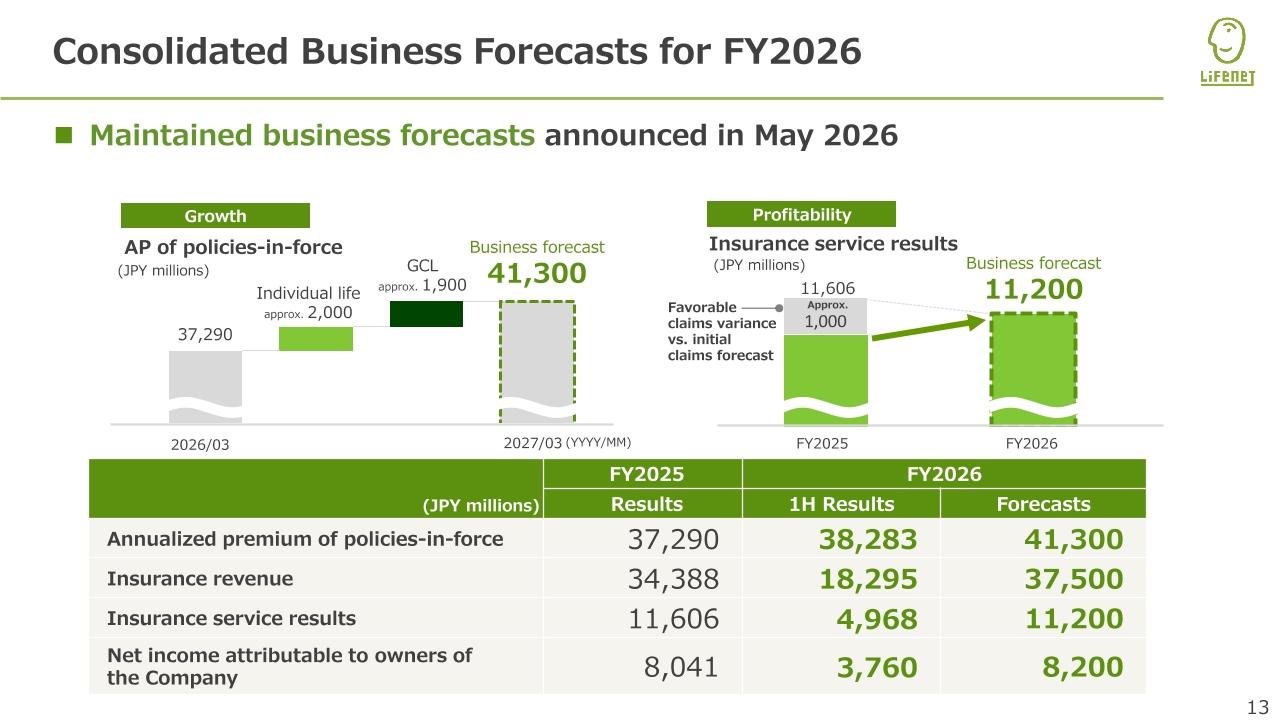
Kawasaki: Please see page 13.
Regarding our consolidated business forecast for FY2026, we will maintain the business forecast that was announced in May 2026. Our performance in H1, both in terms of contract performance and profits, is below our initial targets.
First, regarding contract performance, as explained earlier, we anticipate a contribution in H2 from the transfer of group credit life insurance contracts from THE KYOTO SHINKIN BANK. While the insurance service results have fallen due to the impact of increased insurance payouts, no deterioration in the payment rate due to structural factors has been confirmed at this time. Therefore, we will carefully monitor future payment trends.
Kawasaki: Please see page 14. I will now discuss our view on the market environment.
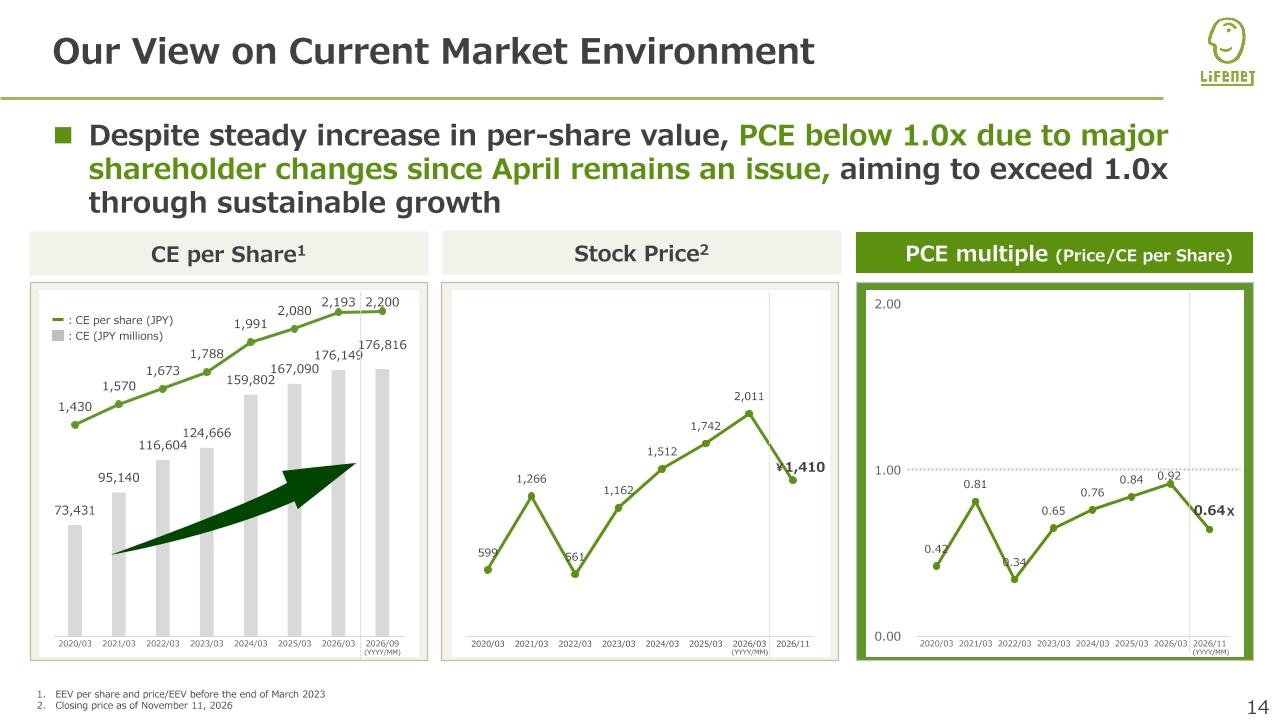
As shown on the left side of the slide, our CE per share, which indicates our corporate value, is maintaining steady growth at JPY2,200. However, the increase from the end of the previous period was limited, and the price to Comprehensive Equity ratio, or PCE ratio, has remained well below 1x due to factors such as changes in capital market expectations resulting from the movement of shares by major shareholders since April.
We take the current situation, where the PCE ratio has fallen below 1x, very seriously as a management team. We candidly acknowledge that this reflects not only insufficient market recognition of our steady accumulation of corporate value, but also the fact that the growth speed of our corporate value itself has not fully met the expectations of market participants.
We will strive to achieve a PCE ratio of over 1x by accelerating our performance growth through our own efforts and powerfully increasing the corporate value itself.
Kawasaki: Please see page 15. We will explain our initiatives to improve the PCE ratio.
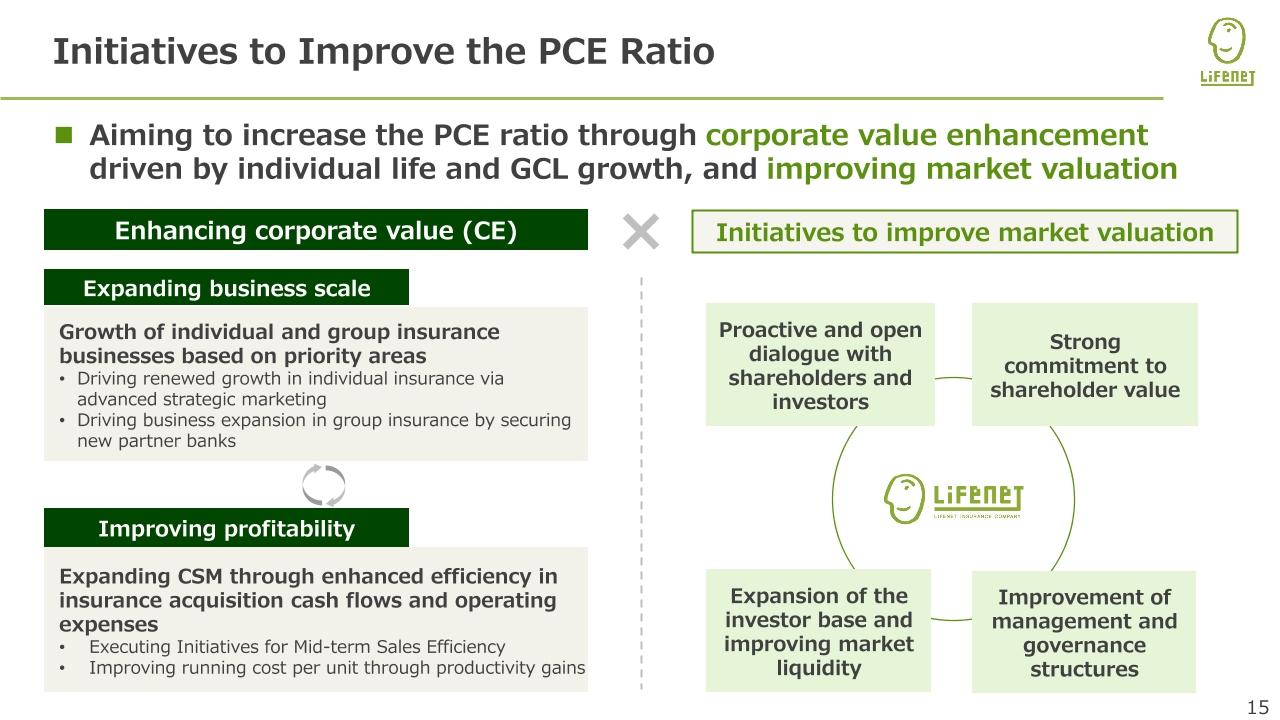
To enhance corporate value and CE, as shown on the left side, and as President Yokozawa will explain later, we will promote the concretization of our AI strategy, co-creation with partner companies including JAL, expansion of scale through acquiring new partner banks for group credit life insurance, and an increase in CSM through enhanced efficiency in sales and operating expenses.
Based on this, in order to improve the market valuation as shown on the right, we will further strengthen our dialogue with our shareholders and investors, based on our strong commitment to shareholder value. In addition to evaluating information disclosure for dialogue, such as updating the disclosure of the cost of capital and issuing integrated reports, we will steadily advance the acquisition of passive funds by leveraging our continued selection as a TOPIX constituent stock and the enhancement of our governance structures by strengthening the functions of our Board of Directors.
The above is a summary of our 2Q financial results.
Now, President Yokozawa will explain the specific initiatives we are taking to accelerate growth in H2 of our mid-term business plan.
Yokozawa: Once again, I am Yokozawa, President and Representative Director. Please see page 17.
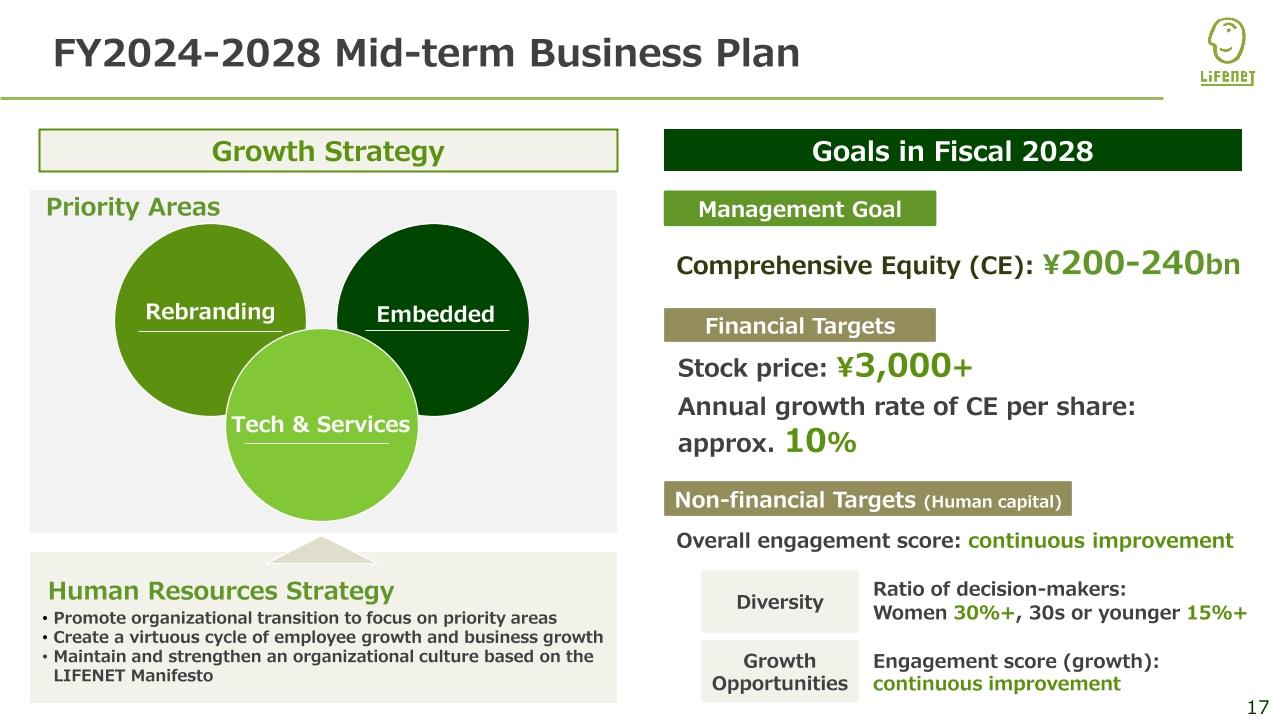
The mid-term business plan we disclosed in FY2024 has just reached its halfway point. Here, I would like to reiterate the overall picture of our mid-term business plan, which will conclude in FY2028.
We will focus on the priority areas on the left, and our management targets for FY2028 are to increase Comprehensive Equity from JPY200 billion to JPY240 billion, and our financial targets are a stock price of JPY3,000 or more and a CE growth rate per share of approximately 10%. This goal will by no means be easy, but we aim to achieve it by further accelerating our growth in the second half of our mid-term business plan.
Yokozawa: Please see page 18. These are the two main focus themes that will drive growth in the second half of the mid-term business plan.
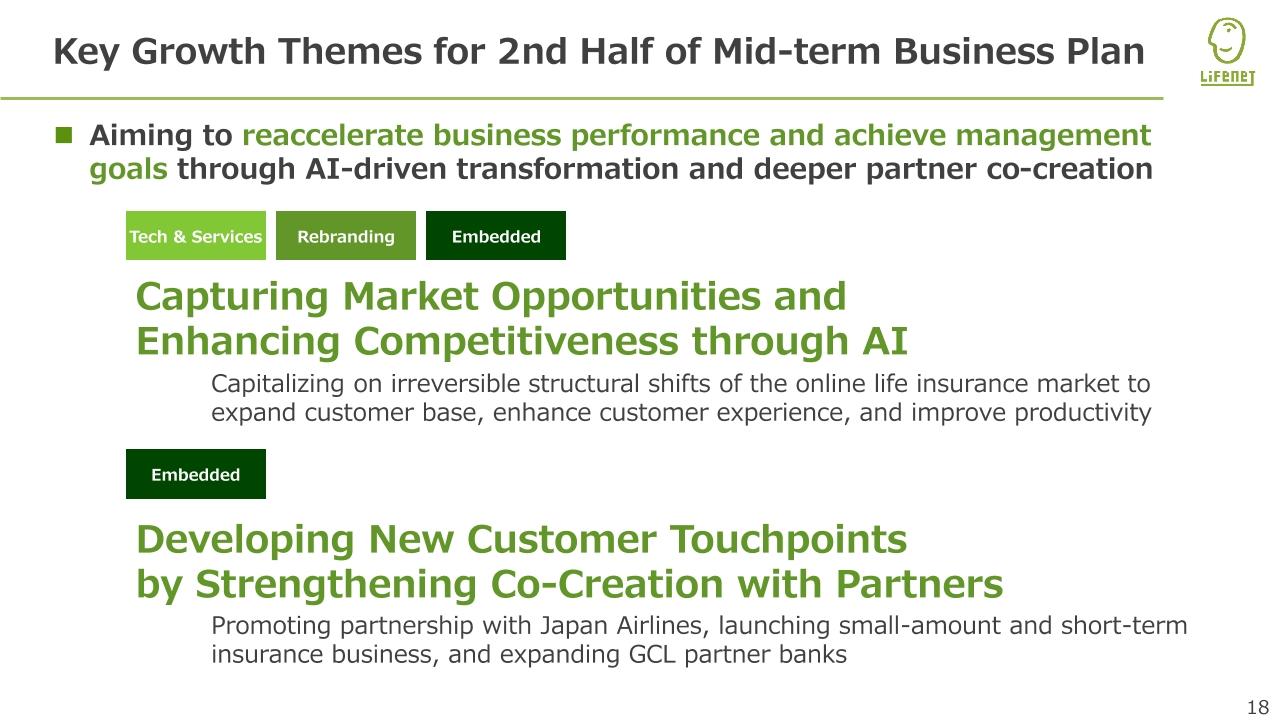
One is to capture market opportunities and enhance competitiveness through AI, and the other is to develop new customer touchpoints by strengthening co-creation with partners.
We will accurately grasp the changes in customer behavior brought about by the rapid spread of AI, thereby expanding our customer base and improving productivity. At the same time, we will strongly promote our partnership with Japan Airlines, the launch of the small-amount and short-term insurance business, and the expansion of our GCL partner banks, thereby shifting our growth gear to the next level.
Yokozawa: Please see page 19. Now, let's move on to the first topic, which is AI strategy.
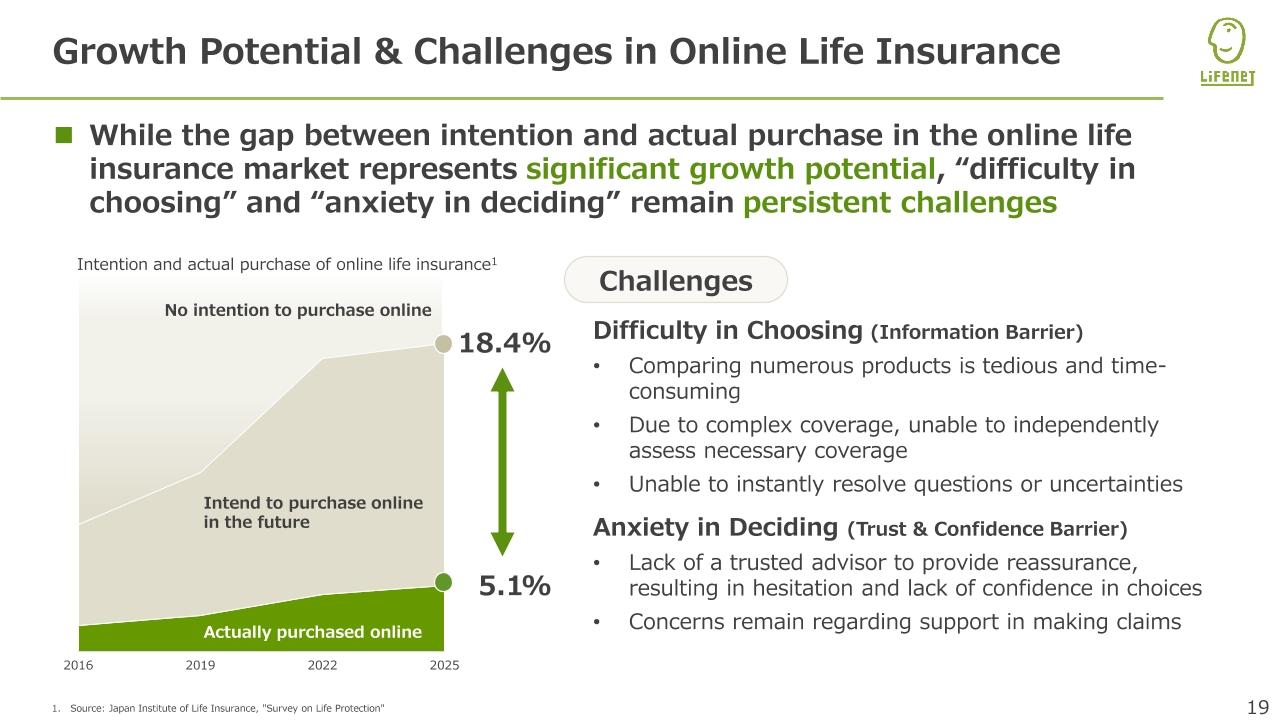
We see the rapid evolution and widespread adoption of AI as a powerful tailwind for the expansion of the online life insurance market and a significant growth opportunity.
First, let me explain the current state of the online life insurance market. As shown in the survey results on the left side of the slide, only 5.1% of respondents have actually purchased life insurance through the internet, while 18.4% intend to purchase it in the future.
We believe this gap demonstrates the high growth potential of the online life insurance market—and of Lifenet itself. At the same time, we recognize that closing this gap is our own challenge as a company leading the expansion of the online life insurance market.
We believe there have been two major barriers for customers that prevented this gap from closing until now.
The first is an information barrier—"difficulty in choosing"—where customers must compare and evaluate numerous products on their own.
The second is a trust and confidence barrier—"anxiety in deciding"—stemming from having no one to consult and lingering worries about support when making a claim in times of need.
By combining the strengthening of our core advantages with the evolution of AI, we will break down these two barriers and actively capture this vast market opportunity, including expanding our reach to segments that previously had no intention of purchasing online.
Yokozawa: Please see page 20.
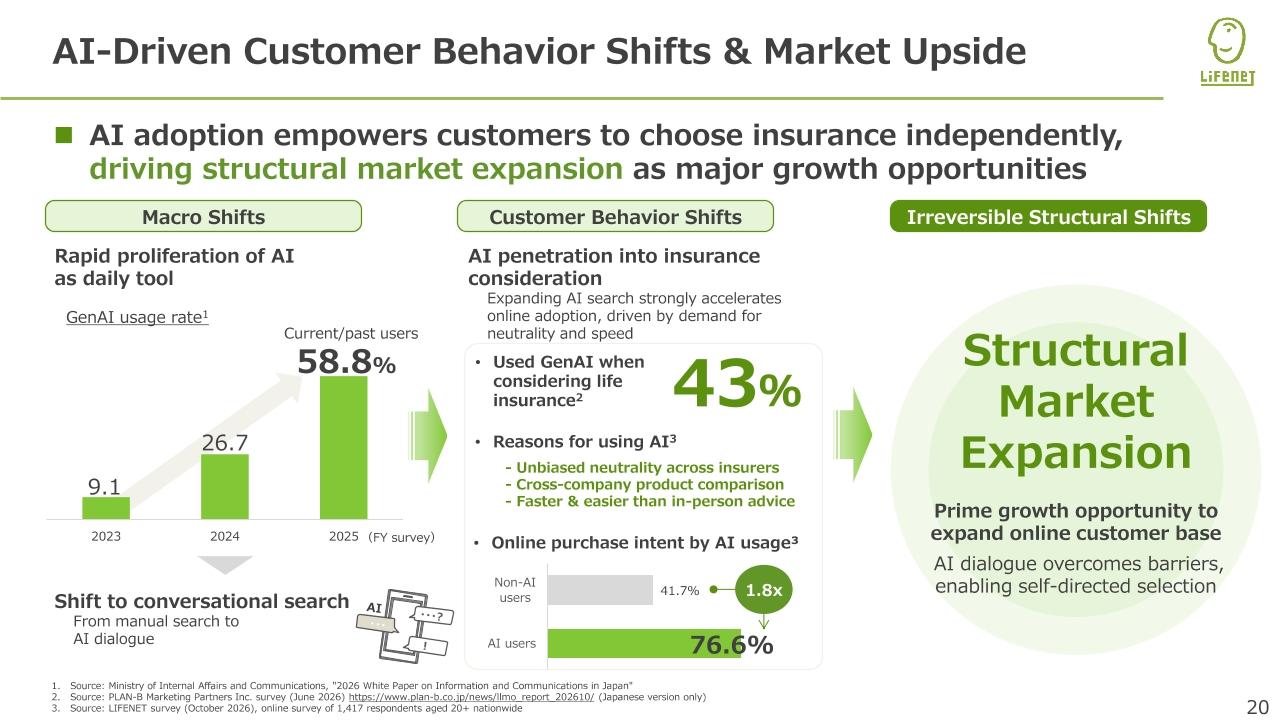
Why, then, does AI represent an opportunity for the future expansion of the online life insurance market? The reason lies in the behavioral changes among customers brought about by the spread of AI.
First, as shown on the left side of the slide, AI is spreading explosively as an everyday tool, shifting the search experience from searching on the web by oneself to discovering through dialogue with AI.
As a result, as shown in the survey in the center of the slide, over 40% of people are already using generative AI when considering life insurance, valuing AI's neutrality and convenience compared to in-person consultations.
Even more noteworthy is that those who used AI have a 1.8x higher intention to choose online life insurance compared to non-users.
Currently, dialogue with AI is gradually removing the first barrier—"difficulty in choosing"— and autonomous insurance selection is beginning to spread.
Combined with the irreversible expansion of AI adoption itself, we see this as an opportunity for structural expansion of the online life insurance market.
Yokozawa: Please see page 21.
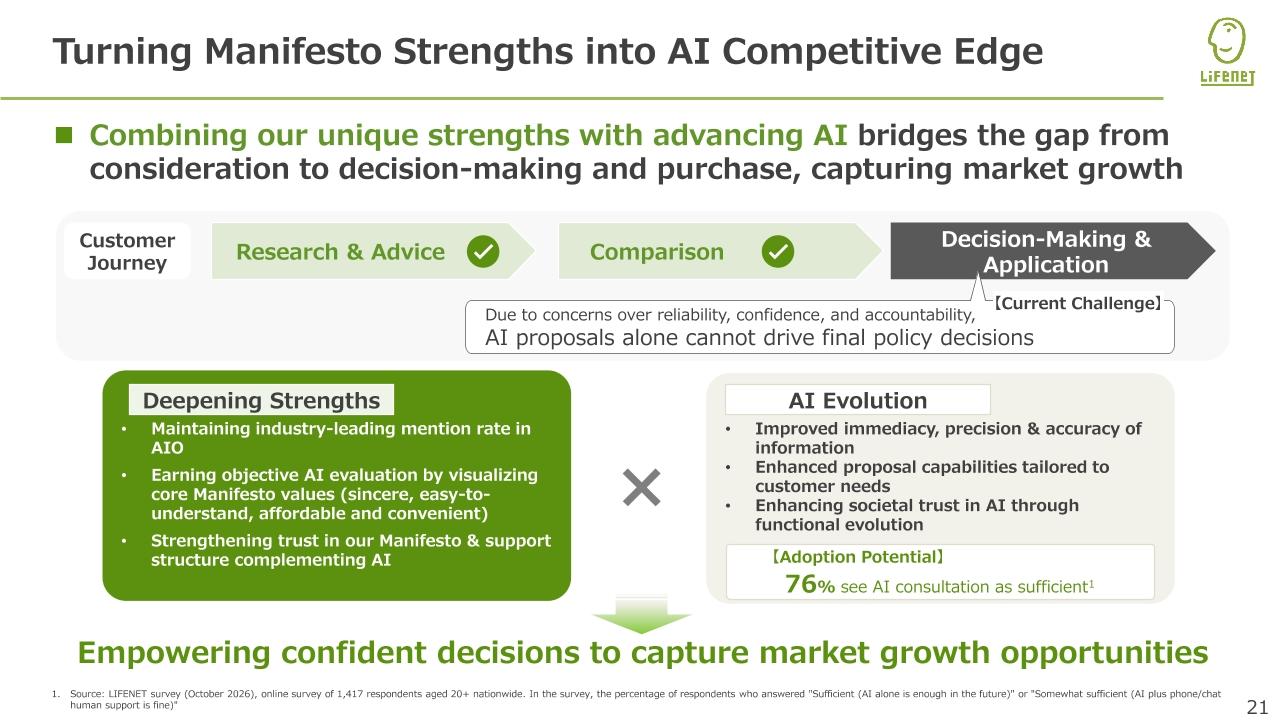
While AI utilization is spreading in the life insurance consideration process, at present it mostly remains limited to information gathering and comparison. According to survey data, about 80% of people respond that they cannot make a final decision based solely on AI recommendations.
Behind this lies the persistence of the second barrier—"Trust & Confidence barrier"—such as concerns over the reliability of AI-provided information, a lack of conviction, and the absence of a responsible entity behind AI. On the other hand, as AI itself evolves in the future, the proportion of people who feel "consulting AI alone will be sufficient for life insurance" reaches 76%.
We will combine the deepening of our unique strengths with this evolution of AI to reach the expanding customer base driven by AI.
As shown under "Deepening strengths" at the bottom left of the slide, we already achieve industry-leading mention rates in AIO (AI Overview), giving us a highly promising positioning in the AI era. We believe this reflects our years of accumulated effort as an online-dedicated life insurer in organizing and communicating clear information on the web.
Moreover, our steadfast pursuit of the four core values set forth in the LIFENET Manifesto since our business commencement —"Sincere, Easy-to-understand, Affordable, and Convenient"—provides the very foundation for demonstrating our strengths in the AI era.
In an upcoming environment where objective, neutral comparisons by AI become commonplace, the value of our Manifesto will be evaluated and visualized, becoming a powerful advantage. While we are still in the stage of testing hypotheses, we will further deepen these strengths.
At the same time, by earning even greater trust in our brand and strengthening our customer support framework, we will empower customers to make confident decisions and boldly take on the challenge of breaking down both barriers.
Yokozawa: Please see page 22.
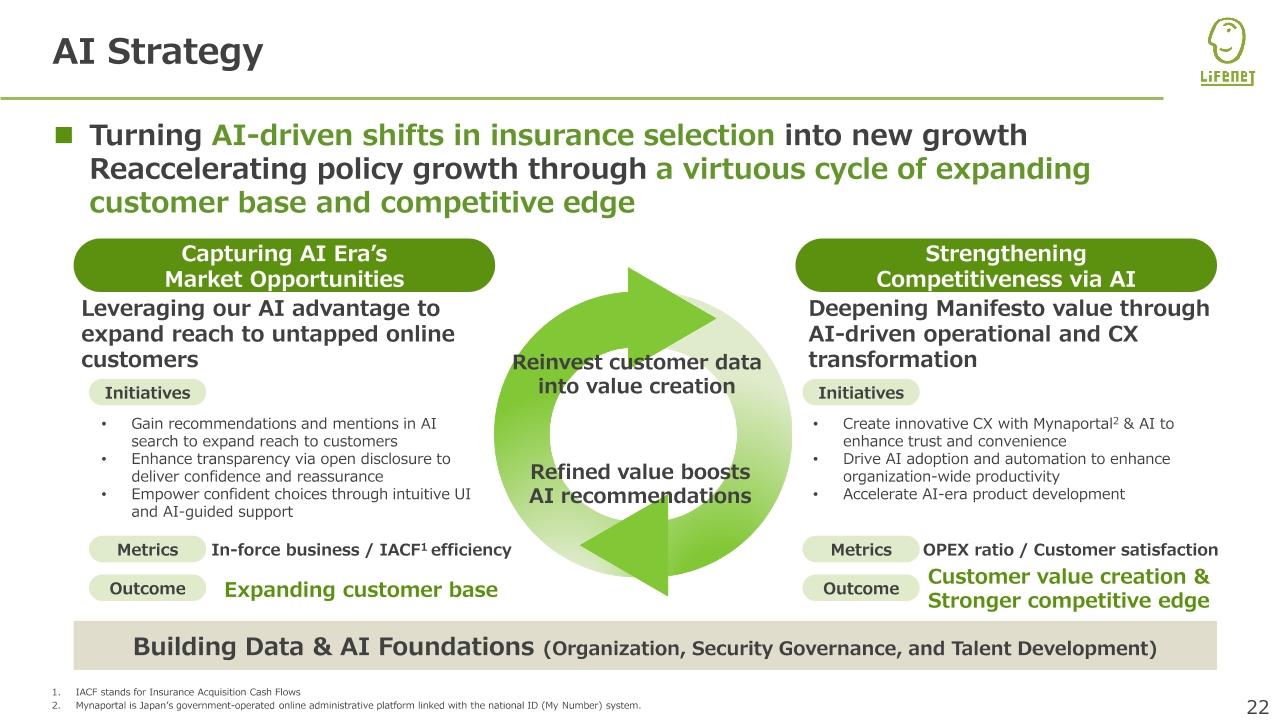
The strategy to put this challenge into action consists of "Capturing AI Era’s market opportunities" and "Strengthening competitiveness via AI," linked together as two wheels in a "Virtuous Growth Cycle Model" that accelerates growth.
"Capturing AI Era’s market opportunities" on the left represents front-end customer acquisition.
By deepening the strengths just described, we aim to expand our customer base by reaching uninsured individuals seeking autonomous insurance options through recommendations and mentions in AI search, thorough transparency, and an intuitive UI.
"Strengthening competitiveness via AI" on the right represents back-end and customer experience (CX) transformation.
We will create innovative customer experiences by fusing Mynaportal integration with AI, while advancing the implementation and automation of AI agents across company-wide processes to reduce operating costs per policy.
We will establish a virtuous cycle in which data obtained through capturing market opportunities is reinvested into value creation to further refine CX and productivity, and that refined core value in turn reinforces recommendations in AI search.
Additionally, as shown at the bottom of the slide, building a data and AI utilization foundation to support this cycle is essential.
Taking the recent rise in cybersecurity threats seriously, we will ensure the safety of customer information by establishing strict security governance, while also advancing talent development and organizational strengthening.
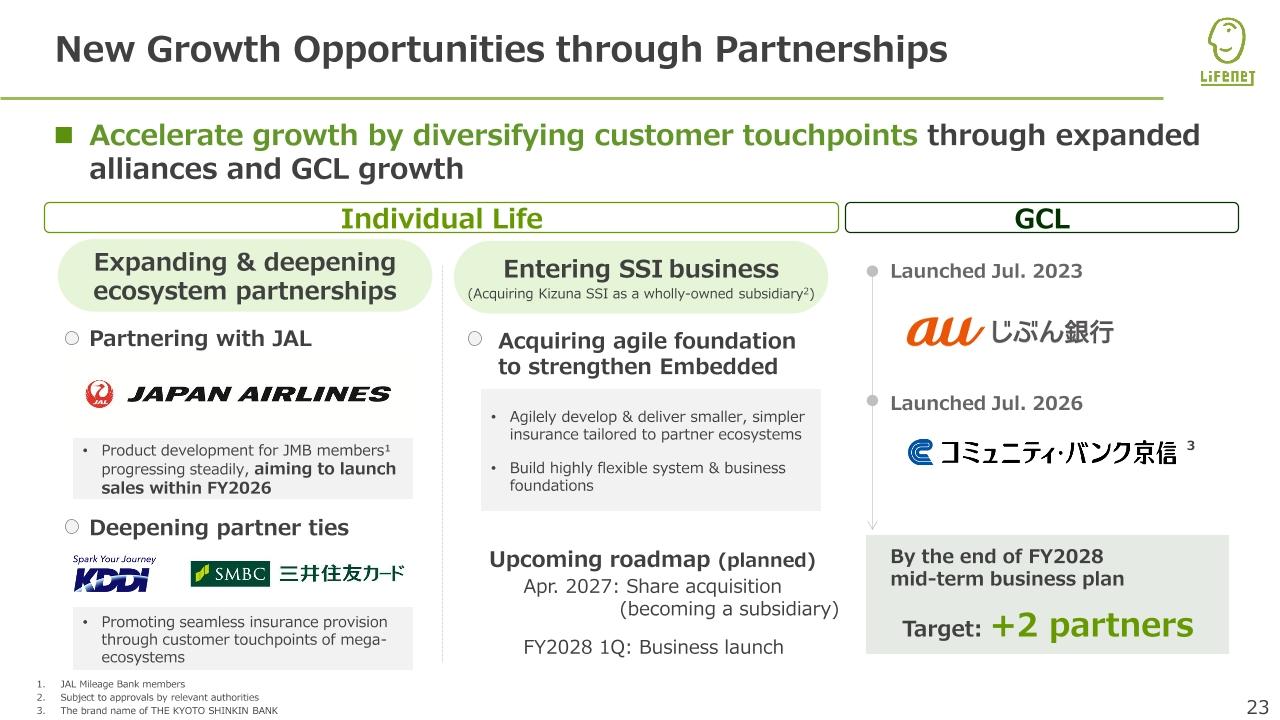
Yokozawa: Page 23 covers our other growth pillar: co-creation with partners.
On the left side of the slide, in our collaboration with Japan Airlines, product development for JAL Mileage Bank members is progressing smoothly, and both companies are working toward launching sales within FY2026. Please look forward to future detailed announcements.
Next, in the center of the slide is our entry into the small-amount and short-term insurance (SSI) business, announced last month in October.
We concluded a share transfer agreement to make Kizuna SSI a wholly owned subsidiary.
By acquiring a SSI license, we will build a flexible foundation capable of agilely developing small-scale, simple insurance products optimized for partner ecosystems. Share acquisition is scheduled for April 2027, with business operations commencing in 1Q of FY2028.
Finally, on the right side of the slide is the expansion of our GCL business.
In addition to our collaborations with au Jibun Bank and THE KYOTO SHINKIN BANK, we aim to form alliances with two more financial institutions during the mid-term business plan.
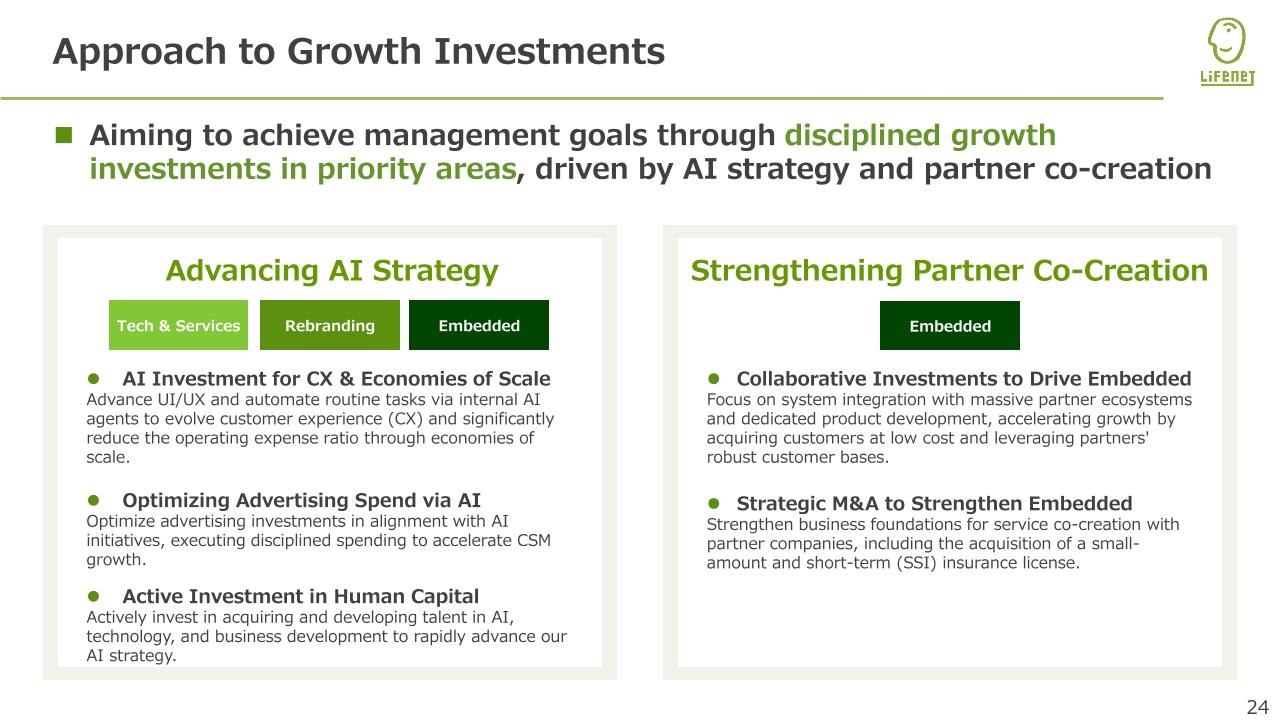
Yokozawa: Page 24 outlines our approach to growth investments supporting these initiatives.
We will execute disciplined investments into our two growth engines: "Advancing our AI strategy" and "Strengthening co-creation with partners."
First, under "Advancing our AI strategy" on the left, in addition to investments aimed at evolving CX, improving internal operational efficiency, and optimizing advertising investments linked with AI initiatives, we will invest in human capital that underpins our AI strategy.
Under "Strengthening co-creation with partners," we will focus on initiatives to embed our offerings even more seamlessly into massive partner ecosystems, investing in product and service development as well as acquiring the business infrastructure necessary for service co-creation with partners.
In this way, we will allocate management resources to areas directly linked to expanding our customer base and improving business efficiency, aiming to achieve our management targets.
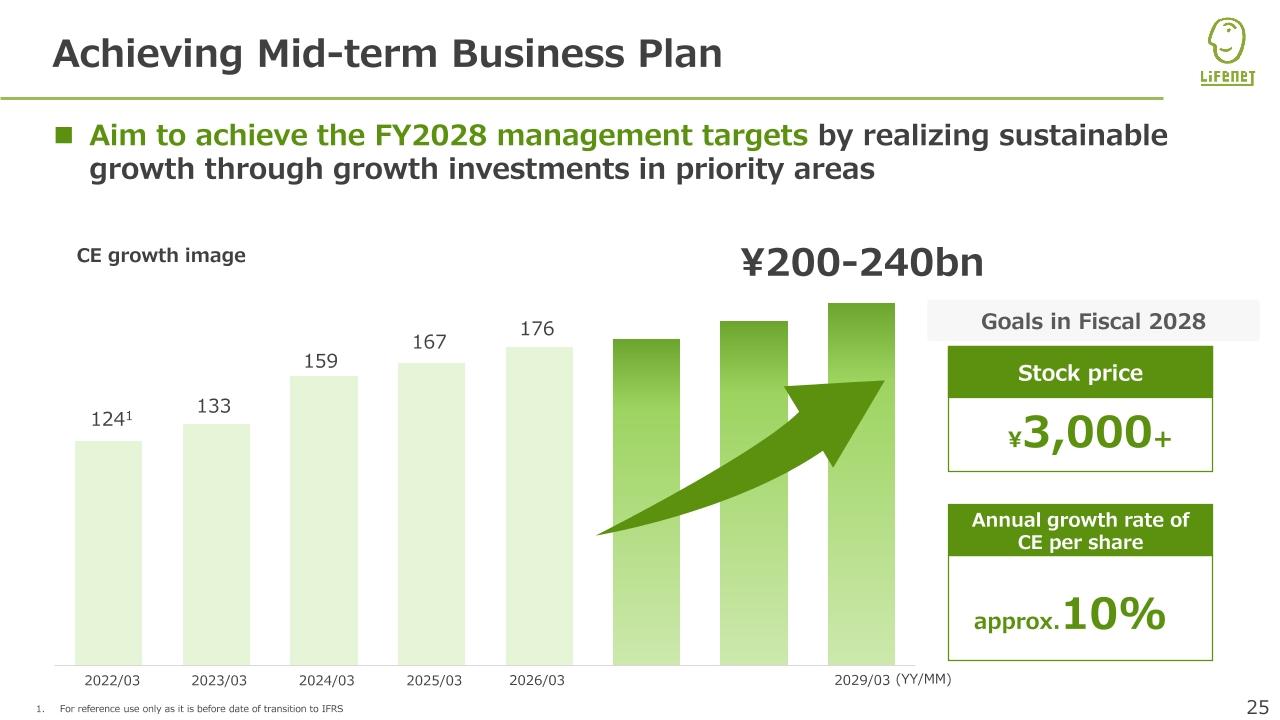
Yokozawa: Finally, please turn to page 25.
By running our two growth engines—"Advancing our AI strategy" and "Strengthening co-creation with partners"—at full throttle and executing disciplined growth investments, we aim to achieve our FY2028 management target of reaching "Comprehensive Equity of 200 billion to 240 billion yen," as well as "a stock price of 3,000 yen+" and "a CE per share growth rate of 10%."
We ask for your continued support and expectations as we take on the challenge of pioneering the future of life insurance.
This concludes our presentation on the FY2026 2Q financial results.
Thank you very much for your attention.